What Screen and Recoat Is
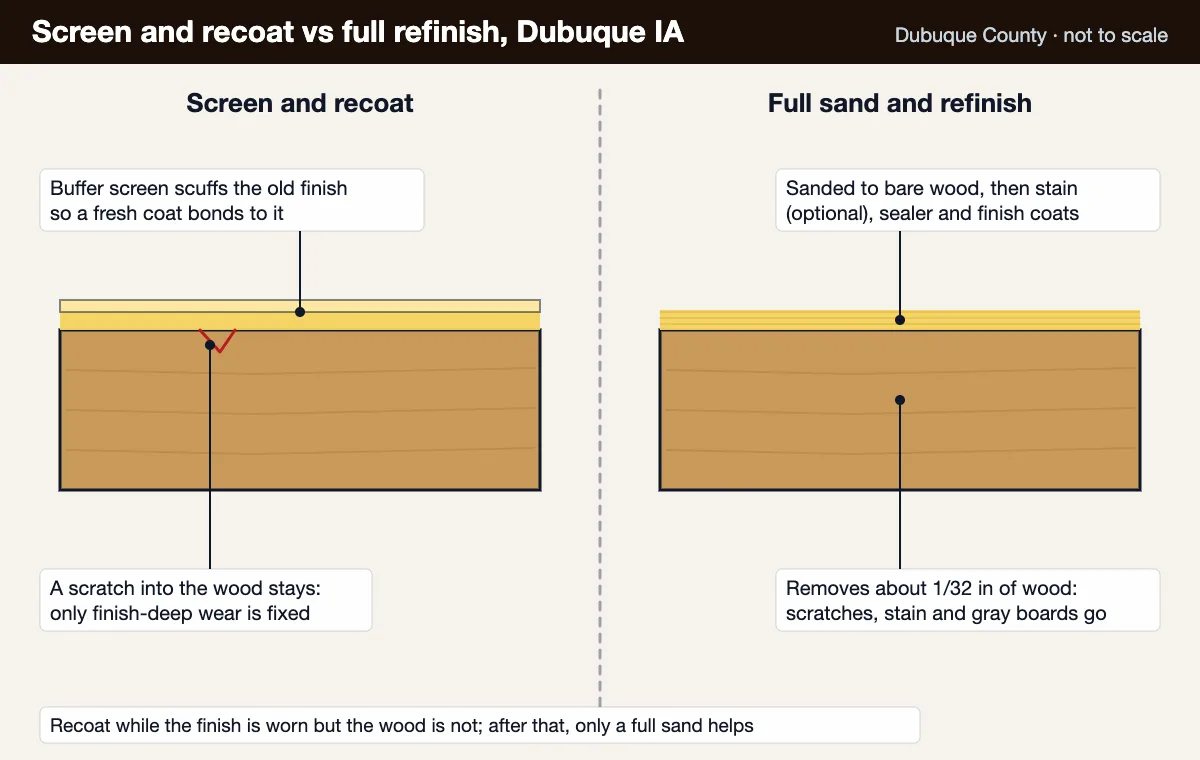
Screen and recoat is a floor refinishing process that refreshes the top layer of finish without sanding down to bare wood. The existing finish is lightly abraded with a floor buffer and screen pad, the surface cleaned thoroughly, and one or two fresh coats of polyurethane applied. The result is a floor that looks significantly better and has renewed protection against wear.
It's the right process when your floor looks dull or hazy, has light surface scratches in the finish layer only, or is simply due for a maintenance coat. It's faster than full refinishing, costs roughly half as much, and light foot traffic is usually fine after about 24 hours.
When Screen and Recoat Is the Right Choice
Screen and recoat works when scratches are in the finish, not the wood. A simple test: look at the scratch at a low angle in bright light. If the scratch reflects light and you can't feel it with your fingernail, it's in the finish and screen and recoat will address it. If the scratch goes into the wood and catches your nail, you need a full refinish.
Screen and recoat is also the right maintenance step for floors that were refinished several years ago and are starting to lose their sheen before any real wear has occurred. Doing a recoat every 3 to 5 years extends the life of the floor and pushes off the need for full refinishing by a decade or more.
The Adhesion Problem: Why Some Floors Cannot Be Recoated

This is the failure mode nobody warns homeowners about, and it's the reason to test before committing. A recoat works by mechanically keying fresh polyurethane into the abraded surface of the old finish. Anything sitting between those two layers breaks the bond, and a coat that hasn't bonded will peel, flake, or lift at the edges within weeks of looking perfect on day one.
The usual culprits, in rough order of how often they turn up:
- Acrylic mop-and-shine products. The supermarket floor restorers that promise instant gloss deposit an acrylic layer on top of the polyurethane. It looks fine for a while, then hazes and goes cloudy. Polyurethane will not bond to it, and screening does not reliably remove it because the acrylic is soft and gums the screen rather than cutting.
- Paste wax. Common on pre-war Dubuque floors that have been maintained the traditional way. Wax has to be fully stripped with mineral spirits before any coating goes down, and even then residue in the grain of open-pored red oak can defeat a recoat.
- Silicone furniture polish. Sprayed on furniture for decades, it migrates onto the floor around the pieces. It produces fisheyes: small craters in the wet coat where the finish physically refuses to wet the surface.
- Oil soaps. Widely used and widely misunderstood. They leave a thin oily film that builds up over years and interferes with adhesion.
- Aluminum oxide factory finishes. Prefinished floors, common in newer West End and Asbury builds, have a factory-cured finish that is extremely hard. It can be recoated but requires more aggressive abrasion and a compatible product, and the bevels between boards trap residue that has to be cleaned out.
The right process is to abrade and coat a test patch in a closet or under where a rug will sit, let it cure, and then try to lift it with tape. If it comes up, the floor cannot be recoated, and you find out before you've paid for a coat that was going to fail. That conversation is uncomfortable and it's a lot better than the one that happens three weeks later.
Going forward, the maintenance rule is simple: clean hardwood with a product made for polyurethane floors and nothing else. No wax, no oil soap, no shine restorer, no steam mop. The Iowa State University Extension guidance on hardwood care linked below covers this well.
Recoat Cadence and When a Full Refinish Wins
Screen and recoat is not a one-time rescue, it's a maintenance rhythm, and understanding that rhythm is the difference between a floor that lasts a century and one that gets replaced in thirty years.
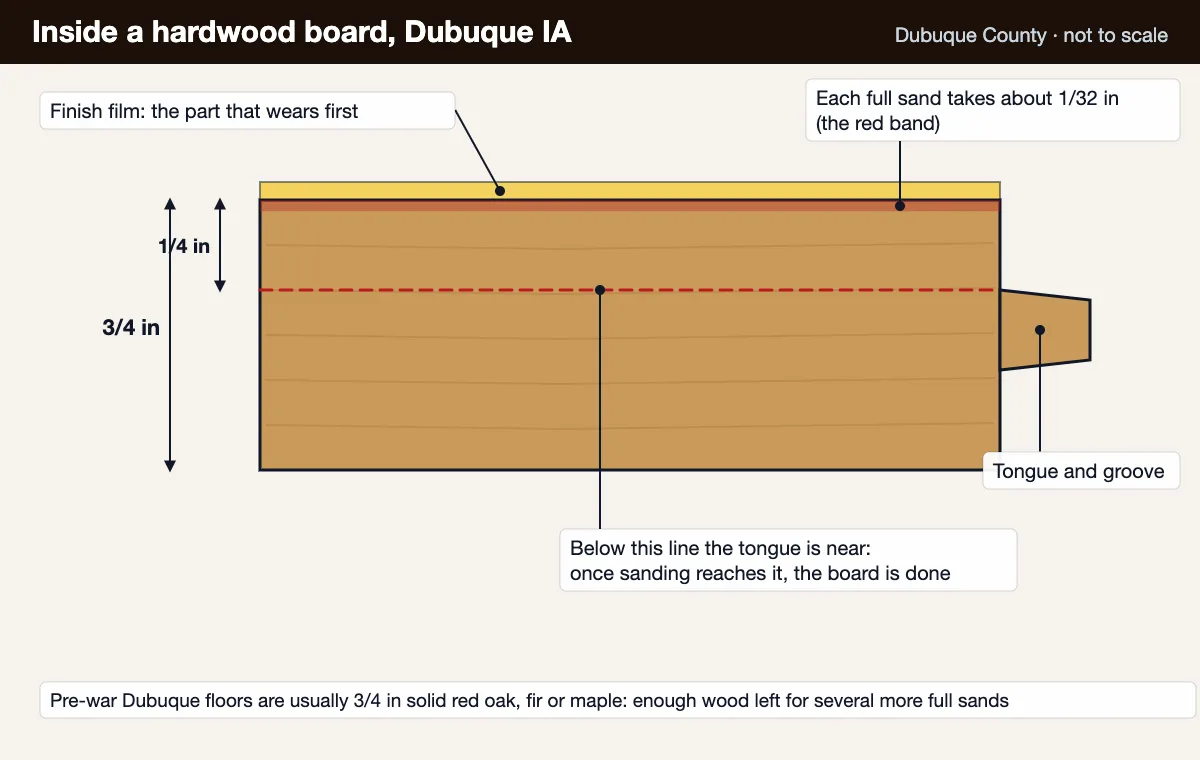
A polyurethane film is a sacrificial wear layer. It's there to be worn instead of the wood. Recoat it before it wears through and the wood beneath is never touched. Let it wear through and grit starts abrading bare wood, at which point only a full sand will fix it, and a full sand costs you a portion of the roughly quarter inch of usable wood your floor has above its tongue.
For a normal Dubuque household, every three to five years is the right interval for living and dining rooms. Two to three years is realistic for entries, hallways, and kitchens, and Dubuque gives those rooms a harder time than most: river-valley grit in summer, and in winter the sand and salt that goes down on the hills and bluff streets rides in on boots and behaves exactly like sandpaper underfoot.
The arithmetic is worth spelling out. A 1,200 square foot floor recoated five times across twenty-five years at roughly $2 per square foot costs about $12,000 and removes essentially no wood. The same floor left alone and fully refinished five times over the same period costs closer to $24,000 and takes roughly 5/32 of an inch off, which is most of its remaining life. Recoating is cheaper per year and it's the only one of the two options that preserves the floor.
Full refinishing wins in four situations, and no amount of recoating substitutes: scratches that have reached bare wood, pet urine that has soaked into the grain and gone dark, water damage or cupping, and any change of stain color. It also wins when a previous recoat has failed adhesion and is peeling, because the failed layer has to come off entirely. If any of those apply, go straight to a full sand and finish rather than spending money on a coat that won't hold up.
Room-by-Room Wear Patterns in Dubuque Homes

Floors do not wear evenly, and where a floor is worn tells you which service it actually needs. Walking a house room by room with a flashlight held low to the floor is the single most useful thing a homeowner can do before requesting a quote.
Entries and mudrooms wear fastest by a wide margin, and in Dubuque the winter is why. Salt and sand from the hill streets come in on boots, sit in a wet film, and grind the finish. An entry frequently needs recoating twice as often as the rest of the house, and it's the one room where three coats are worth pushing for, or or a hard-wax oil that can be spot repaired.
Kitchens wear at the sink and in the traffic lane between range, sink, and refrigerator. The failure here is usually water rather than abrasion: repeated wetting at the sink breaks the film down locally and can reach the wood underneath, which is a full refinish trigger in that room even when the rest of the kitchen is fine.
Living and dining rooms in older Dubuque homes are often the best preserved floors in the house, because a rug covered the center for decades. What you get is a sharp line between a protected field and a worn border, plus a UV color difference where the exposed perimeter has darkened or faded relative to the covered area. A recoat evens out the sheen but does not even out the color. If the color line bothers you, that's a full refinish.
Bedrooms and upstairs hallways generally wear least and are the strongest candidates for a straightforward recoat. In a two-story Cathedral Hill or Langworthy home, it's common for the upstairs to need only a recoat while the main level needs a full refinish, and there's no reason to pay for the same service on both levels.
Stairs are a category of their own. The front edge of each tread takes almost all the wear, and treads worn through to bare wood cannot be recoated meaningfully. Stairs are hand work either way and are quoted per tread.
What Screen and Recoat Cannot Fix
Screen and recoat cannot remove scratches in the wood itself, change the stain color, repair cupped or water-damaged boards, or remove pet stains that have soaked into the wood grain. For any of those situations, a full sand-and-finish is the only option.
Cost and Timeline in Dubuque
Screen and recoat typically costs $1.50 to $2.50 per square foot in Dubuque, roughly half the cost of a full refinish. A standard living room or dining room is usually completed in one day. You can walk on the floor lightly after 24 hours and return furniture after 48 to 72 hours. See our cost guide for more detail.
Frequently Asked Questions
What is screen and recoat for hardwood floors?
Screen and recoat lightly abrades the existing finish and applies fresh polyurethane coats without sanding to bare wood. It restores shine and protection for floors with surface-level wear.
How much does screen and recoat cost in Dubuque IA?
Screen and recoat costs $1.50 to $2.50 per square foot in Dubuque, roughly half the cost of a full refinish. A standard room runs $450 to $750.
When is screen and recoat not the right choice?
Screen and recoat cannot fix scratches that go into the wood itself, change stain color, or repair water-damaged boards. If your floor has deep scratches or pet staining in the wood, a full refinish is needed.
How often should hardwood floors be screened and recoated?
Every three to five years for a normal Dubuque household, and every two to three years in an entry, kitchen, or hallway that takes river-valley grit and winter salt. Recoating on that cadence removes essentially no wood, so it can be repeated indefinitely and pushes a full refinish out by a decade or more.
Why do some floors fail a screen and recoat?
Adhesion. Acrylic mop-and-shine polishes, wax, and silicone furniture sprays leave a contaminant the new polyurethane cannot bond to, and the fresh coat peels within weeks. A careful contractor tests adhesion on an inconspicuous patch before committing to a recoat. If the test fails, the floor needs a full sand instead.
Serving Dubuque and Surrounding Areas
Screen and recoat is covered throughout Dubuque County and the tri-state region. Check our service area for coverage in Iowa, Illinois, and Wisconsin. For more on finish types, see the Iowa State University Extension hardwood floor care guide.