Quick Reference: Dubuque Hardwood Floor Refinishing Prices
These are the ranges currently quoted in the Dubuque, Iowa market, benchmarked against Iowa floor refinishing cost data. Your specific quote depends on floor condition, square footage, and which services are needed. Material costs have risen since these benchmarks were set, so budget toward the upper half of each range for a floor in average or worse condition.
| Service | Per Sq Ft | Typical Room |
|---|---|---|
| Full Sand and Finish | $3.00 to $5.00 | $900 to $1,500 |
| Screen and Recoat | $1.50 to $2.50 | $450 to $750 |
| Board Repair (per board) | $15 to $40/board | Varies by count |
| Stair Tread Refinishing | $25 to $50/tread | Varies |
What Affects the Price
Floor Condition
Floors in good condition with minimal repairs needed come in at the lower end of the range. Floors with multiple cracked or cupped boards, deep pet staining, or water damage that has caused unevenness require more prep work and cost more. Condition is assessed during the free walk-through.
Square Footage
Larger jobs generally have a lower per-square-foot cost because setup, equipment, and travel time are fixed costs spread over more area. A 150-square-foot room costs more per square foot than a 500-square-foot open-plan space. Minimum job sizes exist: most contractors in Dubuque have a minimum of around $500 to $600.
Species and Age
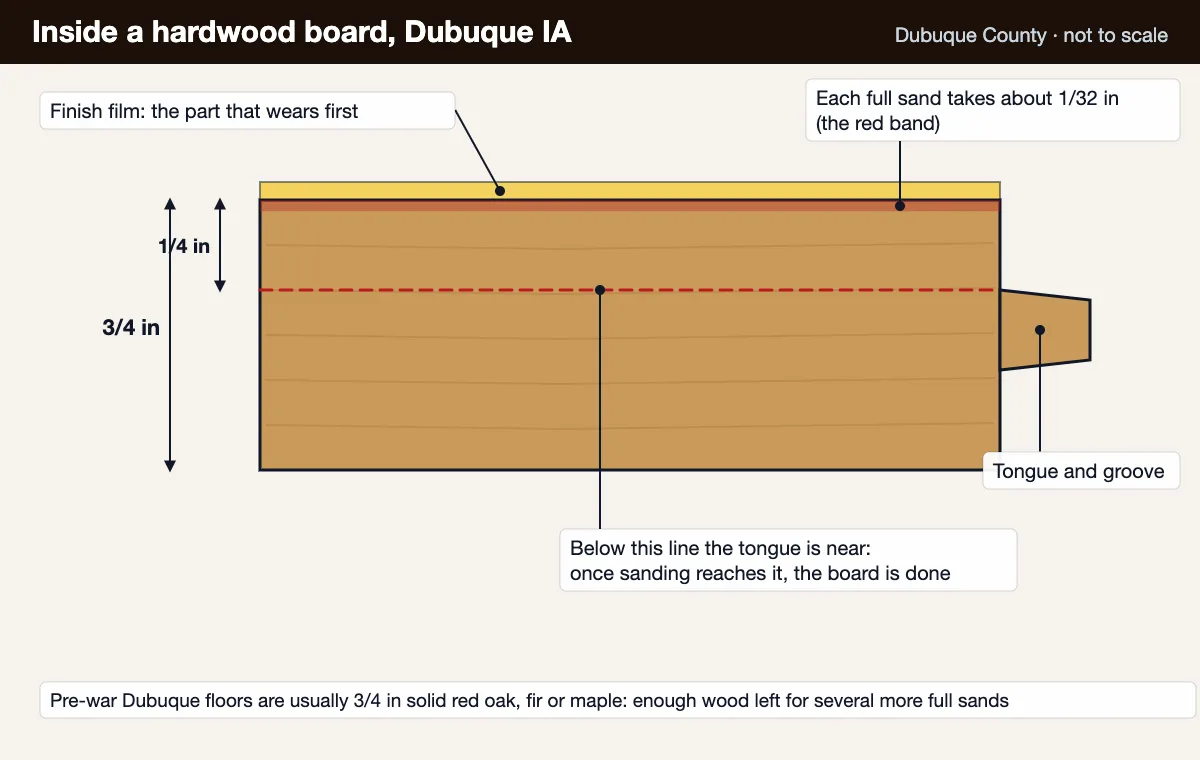
Red oak (the most common species in Dubuque's older homes) sands predictably and is at the low end of difficulty. Douglas fir and old-growth pine, found in some of the city's oldest homes, can be softer and more prone to swirl marks, requiring more care and sometimes more finish coats. Exotic species or unusual widths add time and cost.
Finish Type
Oil-modified polyurethane is standard and the least expensive option per coat. Water-based polyurethane dries faster and is clearer, but costs slightly more per gallon and may require additional coats. Hard-wax oil finishes cost more per coat and require a different application process. Three-coat systems cost more than two-coat but provide significantly better long-term protection.
Stain vs. Natural
Staining adds time and cost: the stain must be applied and allowed to dry before finish coats begin. A natural (no-stain) finish is faster and costs less. Custom stain blends require test samples, which add a small amount to the quote.
Whole-House Cost Examples for Dubuque Homes
Per-square-foot pricing is hard to translate into a real number until you map it onto an actual house. These are worked examples using the $3 to $5 range above, sized to the kinds of homes common around Dubuque County.
| Typical Dubuque Home | Hardwood Area | Full Refinish | Screen & Recoat |
|---|---|---|---|
| Single room (dining or bedroom) | 300 sq ft | $900 to $1,500 | $450 to $750 |
| Main level, small bungalow | 600 sq ft | $1,800 to $3,000 | $900 to $1,500 |
| North End or South End duplex unit | 900 sq ft | $2,700 to $4,500 | $1,350 to $2,250 |
| West End ranch, whole house | 1,200 sq ft | $3,600 to $6,000 | $1,800 to $3,000 |
| Cathedral Hill Victorian, two levels | 1,800 sq ft | $5,400 to $9,000 | $2,700 to $4,500 |
Two caveats on reading that table. First, these figures cover the field: open floor area, sanded and finished. Stairs, closets, and board repair are quoted on top. Second, square footage in an older Dubuque home is rarely one clean number. A Victorian with a parlor, a dining room, a hall, a landing, and four bedrooms upstairs has more perimeter, more doorways, and more edge work per square foot than a ranch with the same total area, and edge work is the slow part of any refinish.
For a rough self-estimate before you contact anyone: measure the length and width of each room getting done, multiply, add them up, and apply $4 per square foot as a midpoint. That number will usually land within 20 percent of a real quote for a floor in average condition.
Costs That Sit Outside the Per-Square-Foot Number
The per-square-foot rate covers sanding and finishing open floor. Several things routinely sit outside it, and this is where two quotes for "the same job" end up hundreds of dollars apart. Ask any contractor which of these their number includes.
- Stairs. Stair treads run $25 to $50 each in the Dubuque market, and risers, stringers, and railings are additional. Stairs are entirely hand work with no machine able to do the bulk of it. A typical 14-step staircase with treads and risers can add $700 to $1,400 to a job, which surprises people more than any other line item.
- Board repair. $15 to $40 per board. A handful of boards is noise. Thirty boards across a water-damaged dining room is a real number. See our board repair page for how that gets priced.
- Carpet, tack strip, and staple removal. Pulling carpet off a floor is quick. Pulling several thousand staples out of a pad that was stapled rather than glued is not, and it has to be done by hand before a machine can touch the floor.
- Old adhesive, linoleum, or tile residue. Common in Dubuque kitchens where vinyl went down over hardwood in the 1960s. Mastic loads up abrasive fast and adds sanding passes. In pre-1978 homes, some of that old sheet flooring and its adhesive may contain asbestos, which is a separate abatement question, not a sanding question.
- Shellac. Many original finishes in pre-war Dubuque homes are shellac, not polyurethane. Shellac softens and gums under friction, clogging abrasive at a rate that can double abrasive consumption on the first cut.
- Water popping. A wetting step before stain that opens the grain for deeper, more even color on oak. It adds a stage and a drying window, and it is worth it on dark stains. Not every quote includes it.
- Furniture moving. Some contractors include it, some do not, some charge by the room. If you have a piano or a large built-in, raise it at the estimate.
- Transitions, thresholds, vents, and shoe molding. Matching new floor vents and reinstalling quarter round after finish is a small cost that shows up as an itemized line more often than people expect.
- Extra coats. Two coats versus three is a real difference in both price and floor life. A kitchen, entry, or any room in a rental should get three.
Water-Based vs. Oil-Based Finishes: The Cost Trade-Off

Finish choice is the second largest lever on price after square footage, and the cheaper option up front is not automatically the cheaper option over ten years.
Oil-modified polyurethane is the lower material cost per gallon and the traditional choice. It ambers over time, which many owners of Cathedral Hill and Langworthy Victorians actively want because it reads as period-appropriate against original oak and walnut trim. The trade-offs are cure time and odor: roughly 8 to 24 hours between coats, a strong solvent smell for a day or two, and a full cure measured in weeks rather than days. In a Dubuque winter with the windows shut, that odor is a genuine consideration.
Water-based polyurethane costs more per gallon and often wants an extra coat, so expect it to sit toward the upper half of the per-square-foot range. What you buy is speed and air quality: recoat in two to four hours, far lower odor, and a finish that stays clear instead of yellowing. On maple, on white oak, and on any floor you want to keep light, waterborne is the correct choice regardless of cost, because oil-modified will pull it amber within a couple of years.
Hard-wax oil is the highest cost per coat and the lowest cost to maintain. It penetrates rather than forming a film, which means a scratched area can be spot repaired with a rag and a bit of oil rather than resanding the room. It needs periodic re-oiling every few years and it does not suit a floor nobody is going to maintain, but for a high-traffic entry in an old house it is often the most economical choice across a decade.
The honest summary: for most Dubuque homes the finish choice moves the total by roughly 10 to 20 percent, and it should be driven by species, light, and how the room gets used rather than by squeezing the quote.
Why Winter and Summer Quotes Can Differ in Dubuque
The per-square-foot rate is fairly stable across the year, but Dubuque's position in the Mississippi River valley puts real seasonal pressure on how a job runs, and that occasionally shows up in a quote.
In summer, valley dew points run high and indoor relative humidity in a house without air conditioning can sit above 60 percent for weeks. High humidity slows oil-modified polyurethane noticeably and can add a full day to a three-coat job. It also makes water-based finish flash unpredictably. A good crew plans for it, but a summer job on a humid week is a slower job.
In winter, the constraint flips. The house has to stay above roughly 65 degrees for the finish to coalesce and cure properly, and you cannot ventilate by opening a window in January without dumping the heat you need. That pushes many winter jobs toward low-odor waterborne finish, which carries a slightly higher material cost, and it means your furnace runs harder for several days. Forced-air heat also drops indoor humidity below 25 percent, and very dry air during cure is generally fine for waterborne but can make an oil-modified film skin over before the body has cured underneath.
Late spring and early fall are the easy windows in this market: moderate temperature, moderate humidity, and the option to ventilate. If your schedule is flexible and you're comparing quotes, those are the weeks to aim for. If it isn't flexible, the work still gets done well in any month, it just needs the conditions managed deliberately rather than ignored. Our timeline guide covers the seasonal cure differences in more detail.
Full Refinish vs. Screen and Recoat: Which Is Worth It?
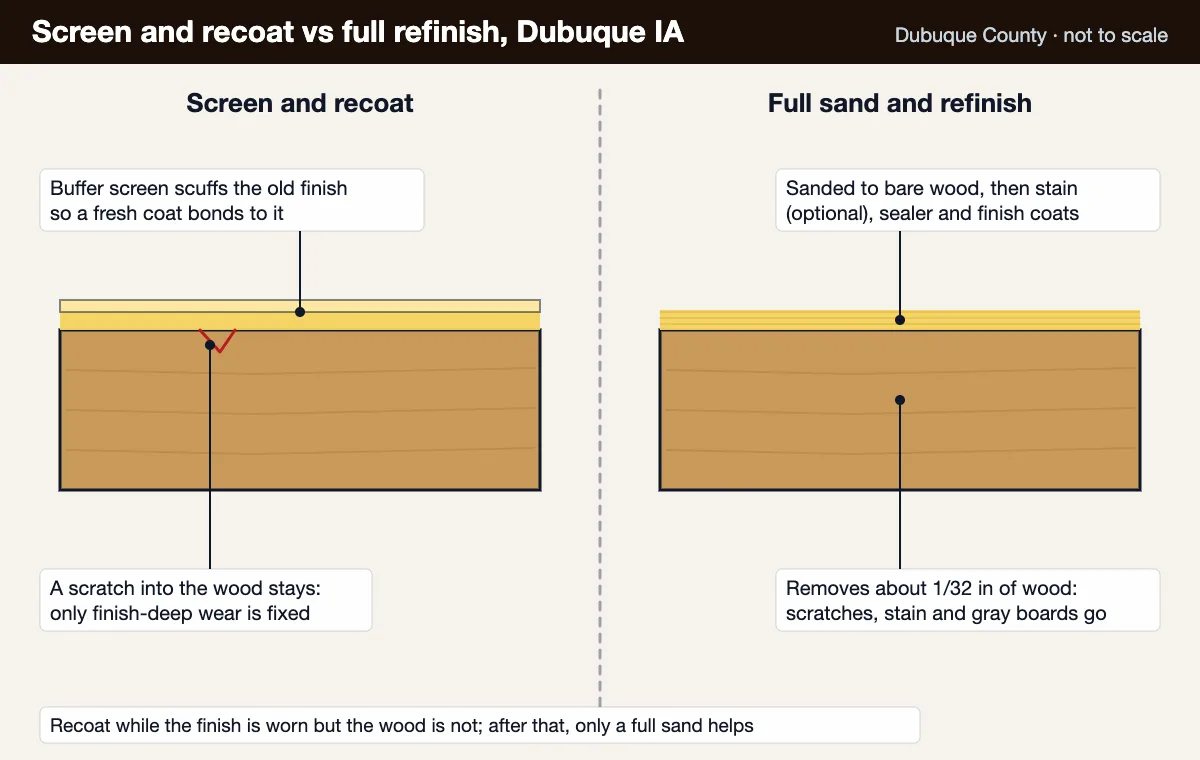
Screen and recoat at roughly half the cost of full refinishing sounds appealing, but it only works when the floor's issues are limited to finish wear. If the wood itself has visible damage, screen and recoat won't fix it. A floor that gets screen and recoat when it actually needed full refinishing will need to be done again within a year or two. A good contractor will be honest with you during the walk-through about which process actually addresses what your floor needs.
Frequently Asked Questions
How much does hardwood floor refinishing cost in Dubuque IA?
Full sand-and-finish costs $3 to $5 per square foot in Dubuque. A 300 sq ft room runs $900 to $1,500. Screen and recoat is $1.50 to $2.50 per square foot.
Is screen and recoat cheaper than full refinishing in Dubuque?
Yes, screen and recoat costs roughly half as much as full refinishing. However, it only works when damage is limited to the finish layer, not the wood itself.
What affects hardwood floor refinishing costs in Iowa?
Key cost factors include floor condition, square footage, species (red oak vs. fir vs. maple), finish type (oil-modified vs. water-based polyurethane), and whether staining is needed.
How much does it cost to refinish hardwood floors in a whole Dubuque house?
At $3 to $5 per square foot, a 1,200 square foot whole-house refinish in Dubuque runs roughly $3,600 to $6,000. A 1,800 square foot Victorian with stairs, borders, and some board repair typically lands between $6,000 and $10,000. Larger jobs sit toward the lower end per square foot because setup and travel are fixed costs spread over more area.
Is there a minimum job size for floor refinishing in Dubuque?
Yes. Most Dubuque contractors have a practical minimum around $500 to $600. Mobilizing a truck, dustless containment, machines, and finish for a small hallway or closet costs nearly as much as doing a full room. If you have a small area, the economics improve a lot if you bundle it with an adjoining room in the same visit.
Do hardwood floor refinishing prices change seasonally in Dubuque?
The per square foot rate doesn't move much, but the job can. Winter work in Dubuque means the house has to be held above 65 degrees for days with no window ventilation, which sometimes pushes a job toward waterborne finish at a slightly higher material cost. Summer humidity in the river valley can add a day of dry time on oil-modified finish. Scheduling in late spring or early fall usually gives you the cleanest conditions.
Get a Specific Quote for Your Floors
Use the form on this page to request a free quote. Expect a follow-up to confirm details; a flat-rate price can usually be given from photos and measurements, with a walk-through for more complex jobs. See also our guide on how long refinishing takes and where we work.