

What Full Sand-and-Finish Refinishing Involves
Full refinishing means sanding the floor down to bare wood, removing everything above it: old finish, stains, surface scratches, minor dents, and any discoloration from water or pets. It's the right choice when a floor has visible scratches in the wood itself, deep water marks, pet staining, or when you want to change the stain color entirely. If the floor only looks dull and the scratches sit in the finish layer, screen and recoat is the faster, cheaper option.
The process starts with a walk-through to assess floor condition, note any boards that need repair, and confirm species. The floor is then sanded with a drum or orbital sander with dustless containment, hand-sand edges and corners, fill any gaps with wood filler matched to the species, and apply finish coats with dry time between each coat.
Species-Specific Refinishing Notes
Sanding is not one process applied to every floor. The species under your feet decides how aggressive the first cut can be, how fine the sanding has to go before finish, and whether stain is even a good idea.
Red Oak (most Victorian and Craftsman homes)
Red oak is the workhorse of Dubuque's pre-war housing stock and the most forgiving floor to sand. It's open-grained, moderately hard at roughly 1290 on the Janka scale, and it takes stain evenly without conditioner. Most original Dubuque oak is 2 1/4 inch blind-nailed strip, though 3 1/4 inch shows up in later builds.
Douglas Fir and Old-Growth Pine (pre-1910 homes)
Homes in the older parts of Cathedral Hill and along West 11th Street often have Douglas fir or old-growth pine rather than oak. Fir is soft, around 660 Janka, with a hard latewood band alternating with much softer earlywood. Run a drum sander too aggressively and it dishes out the soft bands, leaving a washboard you can feel with a bare foot. Old-growth pine is softer still and is often face-nailed with square-cut nails that have to be set below the surface before any machine touches the floor.
Hard Maple (mid-century ranches and split-levels)
Maple is dense and closed-grained, around 1450 Janka. It sands slowly, shows swirl marks that oak would swallow, and blotches badly under pigmented stain. On maple a natural or very lightly toned finish usually works best. If you want a dark floor and you have maple, that's worth a conversation before work starts, not after.
Walnut (borders and inlay in higher-end Victorians)
Walnut turns up mostly as a border or inlay against an oak field in the nicer Victorian parlors. It's softer than oak at about 1010 Janka and sands away faster, so a border can end up sitting low if the whole floor gets the same number of passes. Walnut needs no stain; pigment just muddies the figure.
The Sanding Grit Progression
Diagram: the grit sequence on a red oak floor
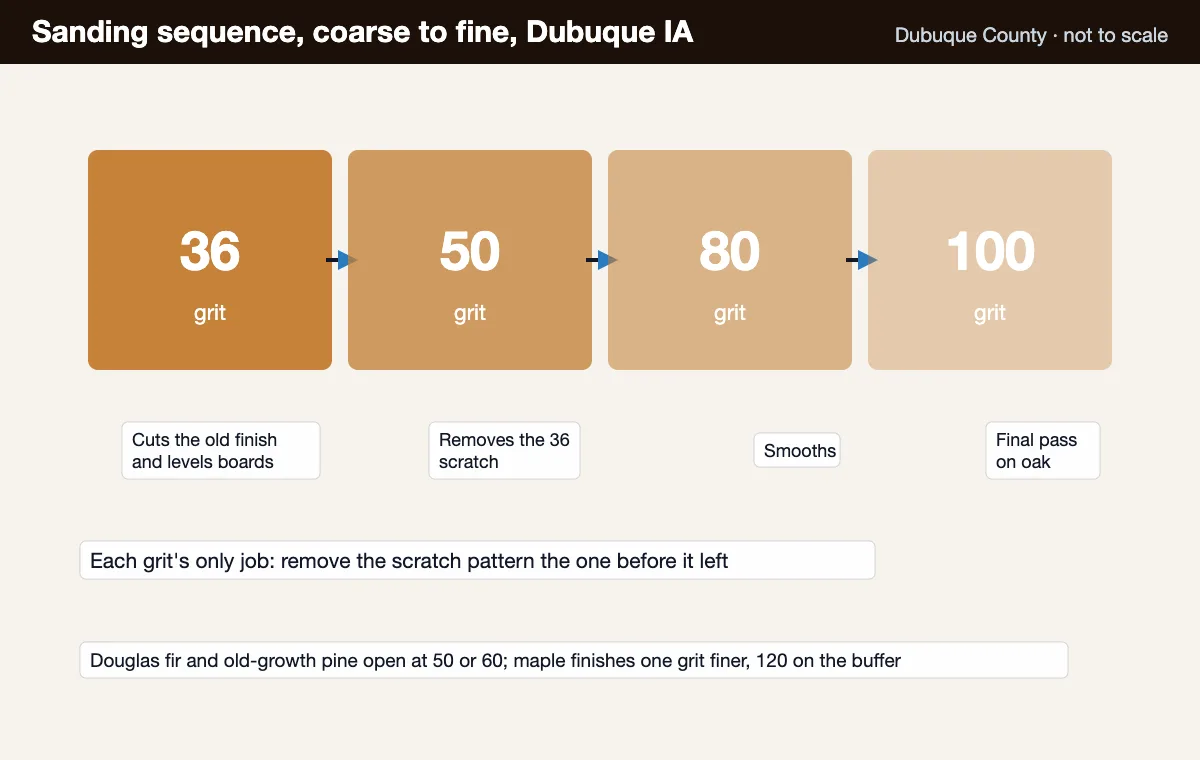
Every full refinish is a sequence of progressively finer abrasives, and each grit's job is to remove the scratch pattern left by the one before it. Jump from coarse straight to fine and the fine grit polishes the coarse scratches instead of erasing them, which you don't see until the first coat of finish lights them up.
On a typical red oak floor in reasonable shape the sequence is 36 grit to cut the old finish and level the boards, then 50, then 80, then a 100 grit final pass. Heavy paint, old adhesive, or a badly cupped surface may need a 24 grit opening cut. A lightly worn floor may open at 50 and skip the 36 entirely, which preserves wood thickness. Douglas fir and pine open at 50 or 60, and maple finishes one grit finer than oak, usually a 120 grit screen on the buffer.
Edges and corners get edger and hand work at matching grits, and the whole floor gets a final buffer screen to blend the edger pattern into the field. That blending pass is what separates a professional refinish from a rental-machine job, where you can usually see a halo around the perimeter of the room once the finish dries.
Mississippi River Humidity and Your Floors
Dubuque sits in the Mississippi River valley, and that puts hardwood floors through a bigger annual moisture swing than most of the country. A house without air conditioning running can sit above 60% relative humidity for weeks in summer; come January, forced-air heat in a pre-war home with original windows will pull indoor humidity below 25%. That's why Dubuque floors open visible gaps between boards in February and close them again by July. It's solid wood doing what solid wood does, not a failed installation.
Moisture readings come before sanding, and the boards should be in a normal service range, generally 6 to 9 percent for solid oak in this climate. A floor filled flat at the peak of a humid August will show its gaps again the following winter, because filler does not shrink with the wood, so gap filling should be conservative, and a seasonal gap should be called what it is. Keep indoor humidity between 30 and 50 percent year round if you can; a whole-house humidifier tied into the furnace does more for a Dubuque floor than any product you can put on top of it. Homes on the river flats in the North End and near the Port of Dubuque also deal with moisture coming up through basements and crawl spaces, which shows up as cupping rather than gapping.
Stain Colors and Finish Options

The full range of Minwax and Bona stain colors is available, from natural (no stain) through classic oak tones, gray washes, dark espresso, and custom blends. For historic Dubuque homes, natural and medium warm tones tend to suit the architecture, but the choice is yours. Finish options include oil-modified polyurethane (most durable, slight amber tone), water-based polyurethane (clearer, dries faster), and hard-wax oil (more natural look, easier spot repair). Pricing by job type is in the cost guide.
Preparing Your Home for Refinishing Day
- Clear the room completely: furniture, rugs, lamps, floor-length curtains, and anything on the walls that vibration could shake loose. Plaster walls hold pictures less securely than drywall.
- Carpet, tack strip, staples, vinyl, and old adhesive all have to come off before sanding. It can be done as part of the job, and on pre-war floors it is better done with care so nobody gouges the boards with a pry bar.
- Point out boards that flex, squeak, or sound hollow during the estimate. Subfloor and joist issues are much cheaper to find before the finish goes on.
- Plan pet and kid logistics. Even with dustless containment there's noise, equipment, and a floor that cannot be walked on for a stretch.
- Decide on stain before day one. Ask for test patches directly on your sanded floor, because red oak in a north-facing parlor reads completely differently than the same stain on a showroom sample.
- Leave the heat or air conditioning set normally. Finish needs a stable room in the 65 to 75 degree range.
You usually don't need to move out. Single-room jobs let you live around the work if you can seal the room off and reach a bathroom without crossing it. Whole-house jobs have a stretch of two to three days where the main level is off limits, and most homeowners stay elsewhere for those nights. The timeline guide covers each stage.
How Many Times Can a Dubuque Floor Be Refinished?
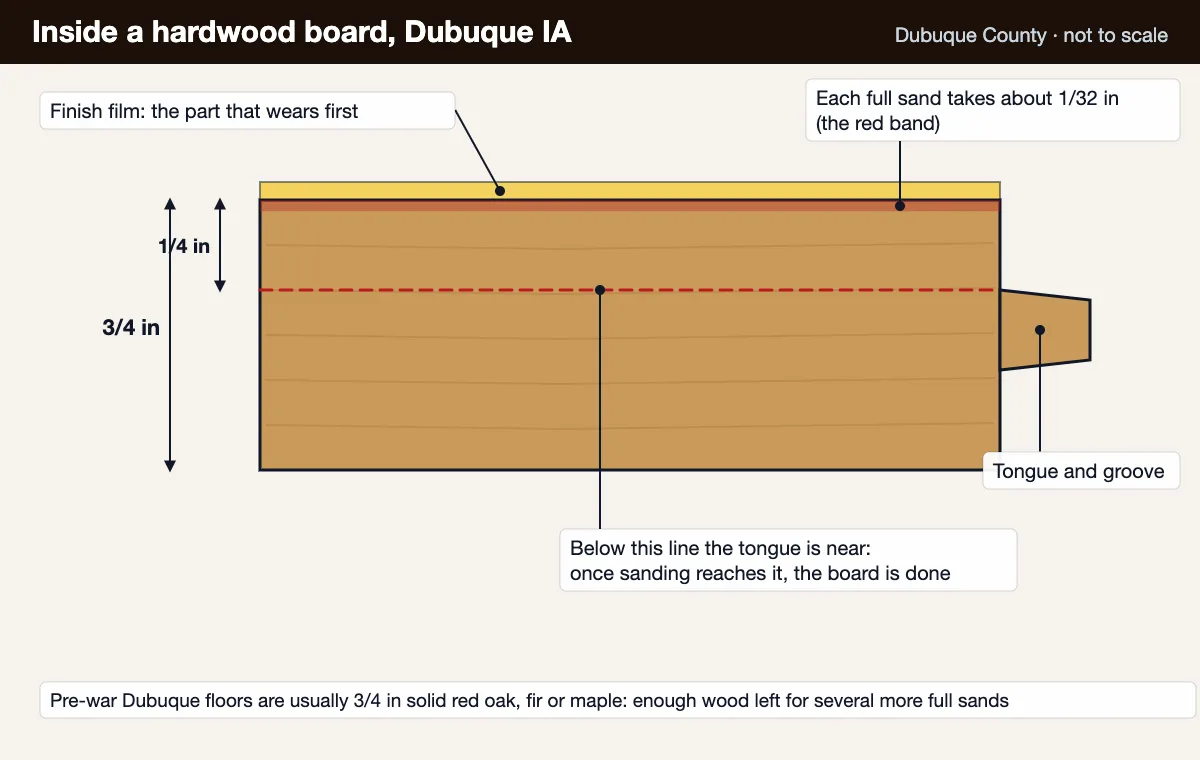
A standard 3/4 inch solid tongue-and-groove board has roughly 1/4 inch of usable wood above the tongue, and a full sand removes around 1/32 of an inch. Most original Dubuque floors have been sanded once or twice, sometimes three times in rentals and converted duplexes, which still leaves decades of life. Remaining thickness should be checked before quoting by looking at the exposed edge at a floor register, stair nosing, or doorway transition.
Floors that genuinely are at the end show the tongue at board edges, nail heads across the field, or uneven wear from an earlier sanding. In those cases an honest refinisher will say so rather than take your money for a sand that exposes fasteners. Often the right answer for a floor near its limit is a screen and recoat, which removes essentially no wood and can be repeated indefinitely.
Refinishing Across Dubuque's Neighborhoods
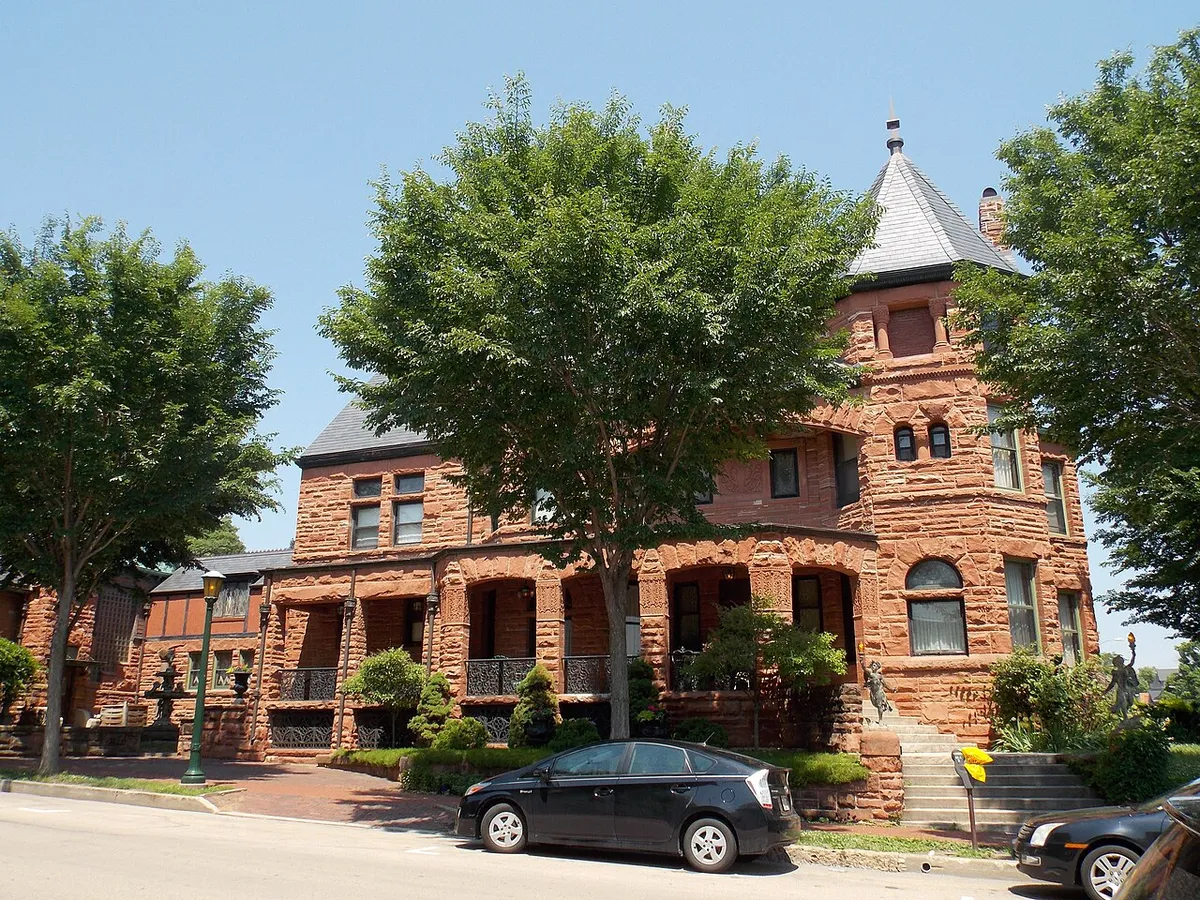
Cathedral Hill and Langworthy have the big Victorians: oak fields with walnut or cherry border inlay, quartersawn oak in the formal rooms, and original shellac that has ambered to near-black in the corners. Shellac needs a different opening approach than polyurethane because it gums up abrasive fast.
West 11th Street and the bluff blocks run older still, and Douglas fir shows up regularly. These floors need the gentlest grit progression and the most patience.
The North End and South End have modest early-century workers' housing and duplexes, much of it with narrow strip oak under decades of carpet. Pulling that carpet is frequently the best surprise a homeowner gets all year, because the floor underneath has been protected since the 1960s. These are also the areas where river-flat basement moisture most often shows up as cupping.
The West End and out toward Asbury and Sageville skew newer: mid-century ranches and split-levels with maple or later oak, plus engineered and prefinished floors in the newest builds. Prefinished floors with heavy bevels can be refinished, but the bevels have to be sanded out entirely, which uses more wear layer.
Downtown lofts above Main Street bring old commercial maple or fir over open framing, often with more deflection than a house floor, and building access that has to be worked out with a landlord before equipment can go upstairs.
