Types of Board Damage That Can Be Repaired
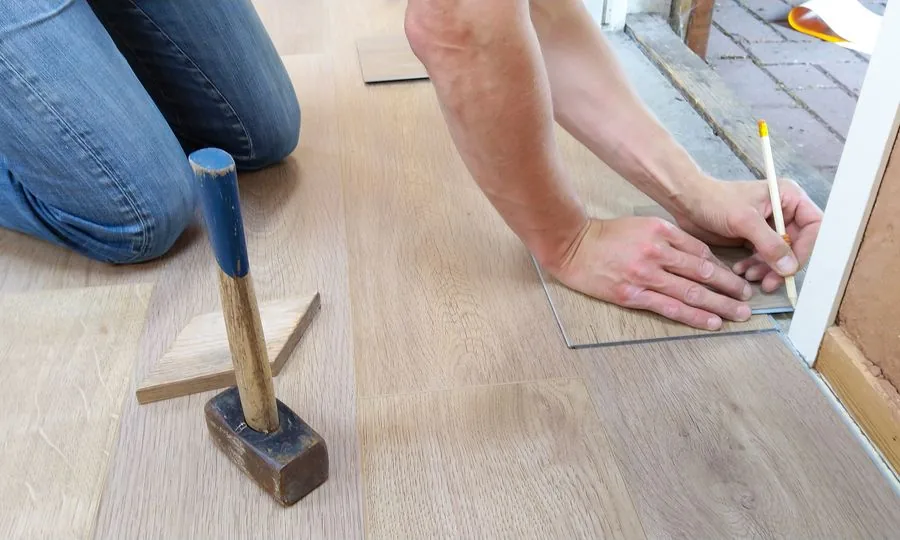
Hardwood floor boards can fail in several ways. Cupping occurs when boards absorb moisture unevenly, causing edges to rise higher than the center. Crowning is the opposite, where the center of a board rises above the edges. Splits and cracks develop in boards that have dried out or been hit by heavy objects. Entire boards sometimes need replacement due to water damage, pet staining that has soaked through, or rot from an old leak.
Each type of damage requires a different repair approach. Cupped boards often flatten after the moisture source is resolved, and may only need light sanding. Cracked boards can sometimes be stabilized with wood filler. Heavily damaged boards need to be cut out and replaced.
Species Matching for Dubuque's Original Floors
Matching replacement boards to original floors is the most technically demanding part of board repair. The most common species in Dubuque's pre-war housing stock are red oak (the dominant species in Victorian and Craftsman homes), Douglas fir (common in very old homes built before 1910), and maple (frequent in mid-century ranch and split-level homes).
New boards should be sourced in the appropriate species and width. After installation and sanding, staining the repair area to match the surrounding floor is the final step. A well-executed repair is nearly invisible after refinishing because the new wood accepts stain and finish the same way as the original.
Repair Methods: Dutchman Patches, Lacing, and Full-Board Swaps
There are three ways to fix damaged wood in a floor, and which one fits depends on how far the damage runs and how much original material is worth saving.
Dutchman patch (damage smaller than a board)
A dutchman is an inlaid patch: a clean rectangle is cut around a knot hole, an old pipe penetration, a burn, or a localized gouge, and a matching piece of the same species and grain direction is fitted into it. Done properly with the grain running the same way and the patch cut with square shoulders, it disappears under finish. This is the right move for something like an old floor register that was abandoned when a Cathedral Hill Victorian got new ductwork, where the goal is to fill the opening without disturbing the boards around it.
Full-board replacement (one board is bad, the rest are fine)
The damaged board gets plunge-cut along its length, the waste is removed in pieces, and a new board of matching species and width goes in. Because tongue-and-groove boards interlock, the bottom of the groove on the replacement has to be removed so it can drop into place rather than slide, and it gets glued and blind-nailed or face-nailed depending on access. This is the most common repair, and it's what the $15 to $40 per board figure refers to.
Lacing (damage runs across several boards)
When a run of boards has to come out, cutting them all off in a straight line and butting new boards to the seam creates a visible scar across the room. Lacing staggers the end joints of the replacement boards into the surrounding field, the same way the original floor was laid, so there's no continuous seam anywhere. Lacing is slower and costs more per square foot than straight replacement, and it's the only acceptable method when a repair sits in the middle of a formal room where people will look at the floor.
Lacing is also what makes it possible to remove a wall or a closet and carry the floor through the old footprint. If you're opening up a kitchen in a Langworthy or West End home and want the hardwood to run continuously into the new space, lacing plus a full refinish is how that gets done without an obvious line where the wall used to be.
Sourcing Match Stock for Pre-War Dubuque Floors
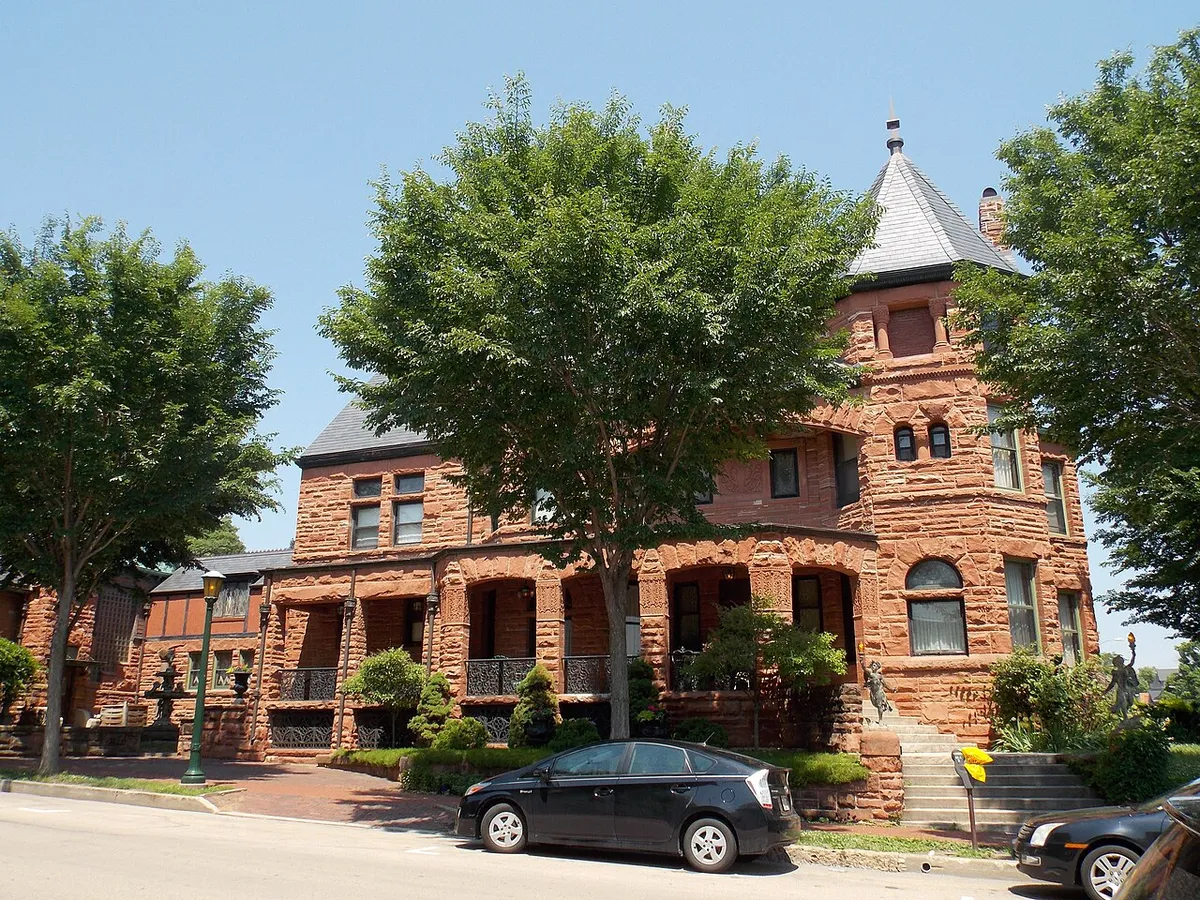
Finding wood that matches is the part homeowners underestimate, and it's where most of the skill in this work actually lives.
Width is the first problem. Most original Dubuque oak strip flooring is 2 1/4 inch face width, which is still manufactured and easy to get. Plenty of it is not. Older homes turn up 1 1/2 inch, 2 inch, and odd widths that predate any standard. When the width is obsolete the fix is to mill stock down to match or source salvage, and salvage from a comparable-era building in the area is usually the better match because the wood has already aged to the same color.
Grain orientation is the second. Quartersawn red and white oak, which shows the ray fleck that Victorian and Arts and Crafts builders liked, does not match plainsawn oak from a big box store. Drop plainsawn stock into a quartersawn Cathedral Hill parlor floor and the patch reads as a patch forever, regardless of how well it's stained. Quartersawn match stock costs more and takes longer to source, and it's non-negotiable if the original floor is quartersawn.
Species is the third. Red oak and white oak look similar to most eyes until finish goes on, at which point red oak's pinker cast against white oak's olive-brown becomes obvious. Douglas fir in pre-1910 homes is frequently vertical-grain old growth with a ring count you simply cannot buy new, so fir repairs almost always come from salvage. Hard maple in mid-century West End ranches is straightforward to source but has to be graded for color, since maple varies from near-white sapwood to tan heartwood within the same tree.
Age and oxidation are the fourth. New wood is lighter than hundred-year-old wood that has been sitting under finish and sunlight. Even a perfect species and grain match starts out too pale. That's what stain adjustment at the repair is for, and it's also why a repair should be done immediately before a full-floor refinish rather than months earlier: the whole floor goes back to bare wood at once, and any residual color difference gets carried by the same stain across old and new together.
Why Boards Cup in Dubuque Basements and Bluff-Side Homes
Cupping is the single most common board failure in Dubuque, and almost every time the board is not the problem. The board is a symptom.
A board cups when its underside holds more moisture than its top. The wet side swells wider, the dry side does not, and the board rolls its edges upward. The moisture is coming from below, and in Dubuque there are three usual sources. Homes on the river flats in the North End and the lower South End sit close to the Mississippi's water table and get chronically damp basements. Bluff-side homes in Cathedral Hill, Langworthy, and along West 11th Street sit against limestone that moves groundwater laterally into foundations after heavy rain. And any house with an unconditioned crawl space pulls humid summer valley air underneath the floor, where it condenses against cooler framing.
Because the cause is below the floor, sanding the floor does not fix it. Worse, sanding a cupped floor flat while it's still wet underneath is the classic way to create permanent crowning: the board dries out later, the edges shrink back down, and now the center stands proud because that's where the wood was removed. Crowned floors are much harder to correct than cupped ones.
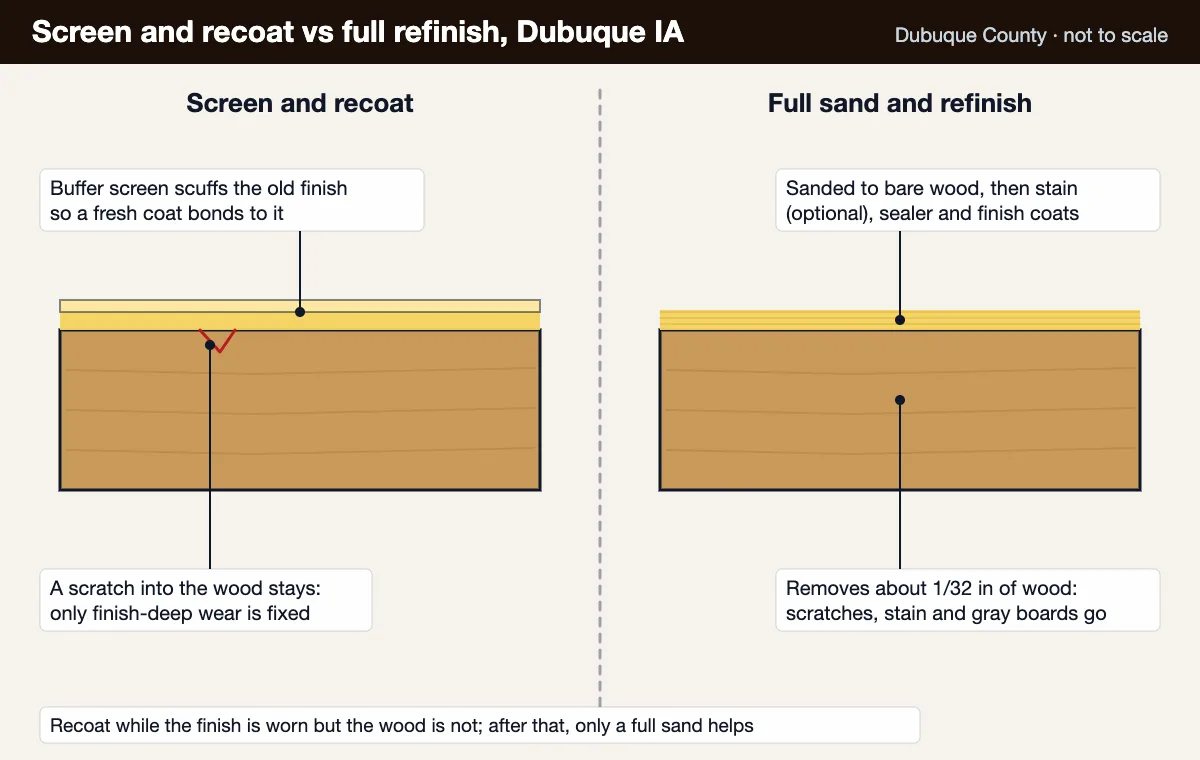
The sequence that actually works is: find and stop the moisture source, let the floor dry and re-flatten on its own over several weeks with moisture readings taken along the way, and only then sand. Many cupped floors flatten so well during drying that they need nothing more than a normal refinish, and a few flatten enough that a screen and recoat covers it. Boards that stay cupped after drying, or that have delaminated, split, or gone black with mold, are the ones that actually get replaced.
If you have a damp basement under a cupped floor, a dehumidifier running to hold the basement near 50 percent relative humidity is usually the cheapest first move, ahead of any floor work at all.
Board Repair Versus Full Floor Replacement
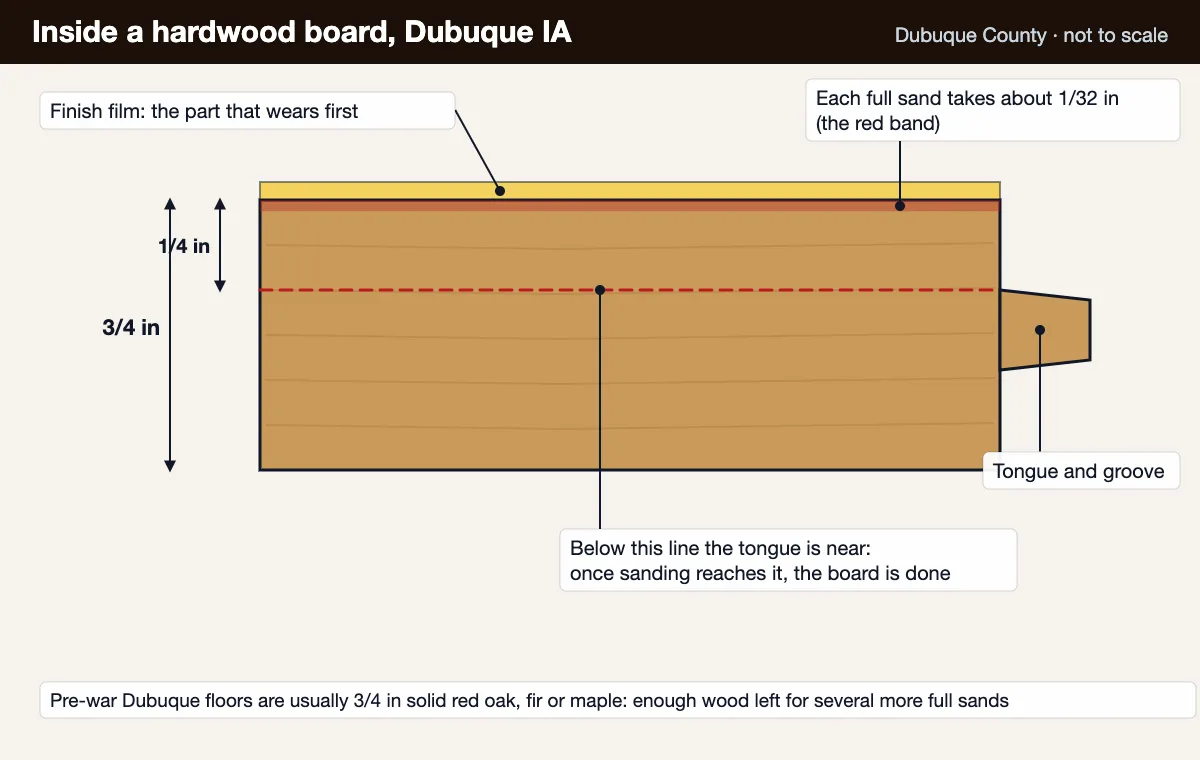
If damage is limited to a specific area, board repair is significantly less expensive than full floor replacement and preserves the original material, which is often higher quality than what can be purchased today. A pre-war red oak floor that has been properly refinished once or twice still has substantial wood thickness. It should be repaired, not replaced.
If more than 40 to 50 percent of the floor has structural damage, replacement may be more practical. You should get an honest assessment after the walk-through.
Board Repair Combined with Refinishing
Most board repair jobs are combined with a full refinish of the entire floor. This is the right approach because refinishing evens out the appearance between old and new boards, and new boards require sanding to blend with the existing floor level. Both are usually done in one visit.
Frequently Asked Questions
Can cupped hardwood floors be repaired without replacement?
Often yes. Cupping usually means moisture imbalance. Once the moisture source is fixed, boards can flatten. Light cupping may only need sanding. Severe cupping may require replacement of affected boards.
Do you match species for board repairs in Dubuque historic homes?
Yes. Replacement boards can be sourced in the correct species and width to match Dubuque's common original floor species: red oak, Douglas fir, and maple. Repairs are nearly invisible after refinishing.
How much does hardwood board repair cost in Dubuque?
Board replacement runs $15 to $40 per board in the Dubuque market, depending on species, board width, and how hard the board is to reach. Obsolete widths and face-nailed Douglas fir sit at the top of that range because the stock has to be milled or salvaged. Most repair jobs also need the surrounding floor sanded and finished, which is quoted separately at $3 to $5 per square foot.
Why do hardwood floors cup in Dubuque homes?
Cupping means the underside of the board is wetter than the top. In Dubuque that usually traces to basement or crawl space moisture, which is common in the river-flat blocks of the North End and South End and in bluff-side homes where groundwater moves through limestone. Fix the moisture source first. Sanding a cupped floor before it dries flat converts cupping into permanent crowning.
Can you repair a hardwood floor without refinishing the whole room?
Sometimes, but the result is rarely invisible. A spot repair blended into existing finish will show as a patch under raking light because new finish and aged finish reflect differently. If the floor is due for refinishing anyway, doing the repair and the full sand in one visit costs less than doing them separately and looks dramatically better.
Service Area
Board repair and replacement is covered throughout Dubuque County and the surrounding tri-state region, including Asbury, Peosta, Dyersville, and Cascade in Iowa, East Dubuque and Galena in Jo Daviess County, Illinois, and Platteville and Lancaster in Grant County, Wisconsin. See our service area or request a free quote.
For pricing on repairs bundled with refinishing, see the cost guide. For how long the combined job takes, see how long refinishing takes. All sanding on repair jobs is done with a dustless containment system.